Restaurant Startup Costs in Dubai: What to Budget For
The costs of opening a restaurant in Dubai: licences and approvals, rent and deposits, fit-out, equipment, visas, staff, marketing and working capital.
Key takeaways
- Rent, fit-out and kitchen equipment are usually the biggest startup costs; licences are smaller but unavoidable.
- Budget for working capital (often three to six months of running costs) and a 10 to 15% contingency.
- Taking over a fitted restaurant, starting as a cloud kitchen or leasing equipment can cut the upfront bill.
On this page
There’s no single answer to what it costs to open a restaurant in Dubai. A small takeaway in a fitted unit and a 120-seat restaurant in a mall can differ by millions of dirhams. What’s consistent is the list of costs: rent, deposits and fit-out usually dominate; licences and approvals are smaller but unavoidable; and working capital is the item new owners most often underestimate. This guide walks through every category, what drives each one and how to build a realistic budget.
The cost categories at a glance
| Category | What it covers | What drives the cost |
|---|---|---|
| Licences and approvals | Trade licence, municipality permits, civil defence approvals, signage | Activity type, number of approvals, consultant fees |
| Premises | Rent, security deposit, agency commission, Ejari, service charges | Location, size, mall or street, lease terms |
| Design and fit-out | Architecture, MEP works, flooring, ceilings, lighting, washrooms | Condition of the unit, concept, finishes |
| Kitchen equipment | Cooking line, refrigeration, extraction hood, fire suppression, dishwashing | Menu complexity, new or second-hand |
| Front of house | Furniture, décor, tableware, outdoor seating | Seat count and design ambitions |
| Technology | POS, kitchen screens, Wi-Fi, CCTV, delivery tablets | Number of terminals and integrations |
| People | Visas, medical tests, Emirates ID, health insurance, recruitment, pre-opening salaries | Headcount and nationality mix |
| Pre-opening | Opening stock, uniforms, smallwares, marketing, soft launch | Concept and launch plans |
| Working capital | Cash to cover losses until the restaurant breaks even | How quickly sales build |
| Contingency | A buffer for overruns and delays | Complexity of the project |
Licences and approvals
Every food business needs a trade licence from the Department of Economy and Tourism (DET), or from a free zone authority if the location allows it, plus food safety approvals from Dubai Municipality. Expect costs for:
- Trade name reservation and initial approval
- The trade licence itself, renewed every year
- Dubai Municipality approvals for your kitchen layout and food establishment permit, and a trained Person in Charge
- Civil defence approvals for fit-out and fire safety systems
- Permits for signage and, where applicable, outdoor seating
Many owners use a licensing consultant, which adds fees but can save weeks. Our step-by-step guide to opening a restaurant in Dubai explains the sequence, and the Dubai food trade licence guide covers licence types. Food safety requirements, from staff training to temperature logs, are set out in Dubai Municipality food safety rules.
Premises
Rent is usually the largest ongoing cost and a large upfront one:
- Rent is quoted per year, often per square foot, and landlords commonly ask for payment in one to four cheques in advance.
- A security deposit is standard.
- Agency commission applies if you use a broker, typically a percentage of annual rent.
- Ejari registration of the tenancy contract is required.
- Mall units often add service charges, marketing levies and rent linked to a percentage of turnover.
- Key money is sometimes asked when you take over an existing restaurant’s lease and fit-out.
Negotiate a rent-free fit-out period. Building works often take several months, and paying full rent on a unit that can’t trade is a common way to burn cash.
Fit-out and kitchen equipment
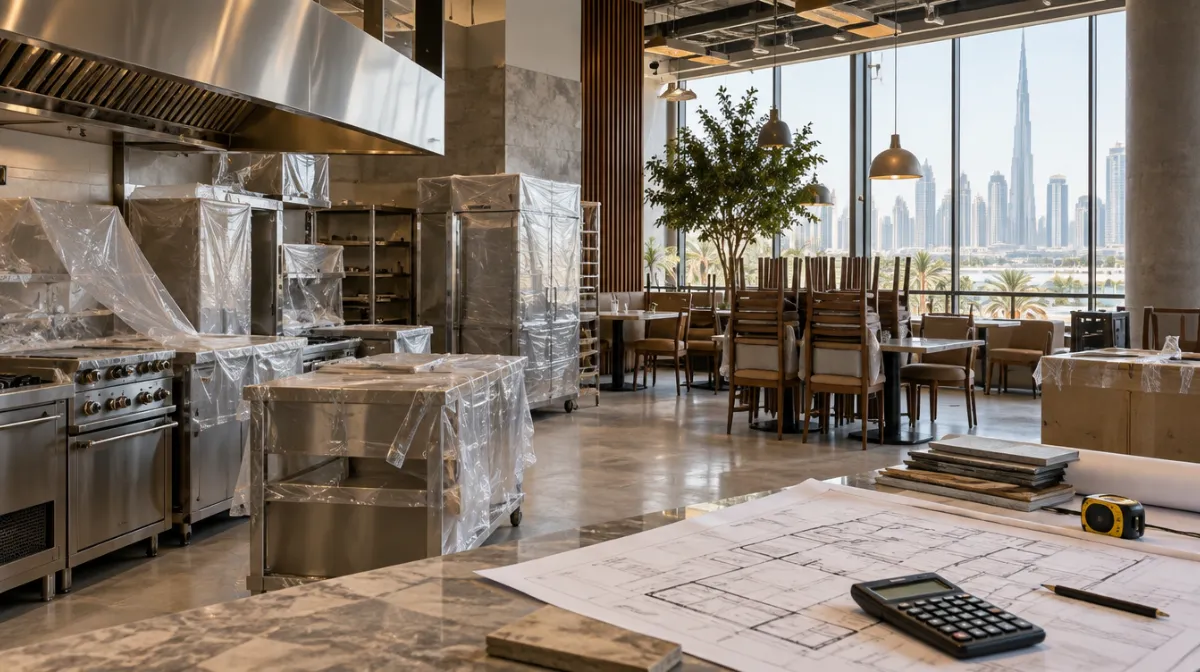
Fit-out costs vary more than any other line. A shell-and-core unit needs everything: mechanical, electrical and plumbing works, extraction ducting, a grease trap, gas or electrical supply upgrades, flooring and washrooms. A former restaurant may already have the expensive infrastructure.
For equipment:
- Buy for the menu. Every item on the cooking line should earn its place.
- Consider quality second-hand equipment for items such as stainless steel tables and shelving.
- Lease or finance expensive refrigeration and combi ovens to protect cash.
- Include installation, commissioning and service contracts in quotes.
People
Employers in the UAE pay for employee visas and related costs, including medical tests and Emirates ID, and health insurance is mandatory for employees in Dubai. Also budget for:
- Recruitment fees or advertising
- Pre-opening salaries for training weeks before you open
- Food safety training for food handlers
- Accommodation or transport allowances, if part of your packages
- End-of-service gratuity, which builds up from day one and should be accrued
Working capital and contingency
Most restaurants take months to reach steady sales. A common planning rule is to hold three to six months of operating costs (rent, salaries, utilities, supplies) as working capital, plus a contingency of 10 to 15% on fit-out and pre-opening budgets. These are rules of thumb, not requirements; the right buffer depends on your concept and your own risk tolerance.
Build your budget in six steps
- Define the concept: seats, size, menu and service style.
- Shortlist sites and ask each landlord for every charge in writing.
- Get three quotes for fit-out and equipment.
- Price licensing and approvals with DET, Dubai Municipality or a consultant.
- Model monthly running costs and add working capital.
- Stress-test the plan at 70% of your expected sales. If the numbers break, change the plan before you sign.
Setting prices that cover these costs matters as much as controlling them; see our guide to menu pricing and food cost.
Ways to reduce startup costs
- Take over a fitted restaurant with an existing kitchen and extraction.
- Start delivery-only from a shared kitchen; see cloud kitchens in Dubai.
- Go mobile with a food truck, which has its own permits; see food trucks in Dubai.
- Consider a franchise if you want a proven system, but add franchise fees and royalties to your model; see food franchising in the UAE.
- Open in phases, starting with a smaller menu and adding services later.
Common budgeting mistakes
- Underestimating fit-out time and paying rent while you build
- Forgetting delivery commissions in revenue forecasts; our guide to food delivery apps explains the fees
- Spending on décor before the kitchen is right
- Having no contingency for approvals that take longer than planned
Frequently asked questions
How much does it cost to open a restaurant in Dubai?
It depends on size, location, fit-out and concept. Build your estimate from quotes for each category above rather than relying on a headline figure, and add working capital and contingency.
Do I need a local partner to open a restaurant in Dubai?
Since reforms in 2021, many mainland activities, including many food and beverage activities, allow 100% foreign ownership. Requirements depend on the activity, so check with DET or a licensing adviser.
What is usually the biggest startup cost?
Fit-out and the upfront rent and deposits are usually the largest items, followed by kitchen equipment.
Sources

Every article is edited by a human and checked against our editorial policy. Spotted a mistake? Tell us.